
Super-Resolution Microscopy: How Oxxius Lasers Power Rimeo’s LiveDRIM
Turning any lab microscope into a super-resolution imaging instrument, without changing the objective or the camera: that’s the challenge Rimeo has taken on with LiveDRIM, its module built on RIM (Random Illumination Microscopy) technology. The company relies on a laser combiner loaned by Oxxius, allowing it to showcase its technology without having to invest in a laser source from day one.
A technology born from academic research
Super-resolution microscopy today spans several families of techniques, but most of them require very precise control over how the sample is illuminated. That level of control, in turn, adds significant complexity, both to the optical system itself and to its day-to-day use on an imaging platform.
Starting from that observation, the research group that included Simon Labouesse developed RIM (Random Illumination Microscopy), the technique behind Rimeo’s founding. The core idea: demonstrate that random, uncontrolled illumination of the sample can still yield a highly precise image, thanks to a proprietary reconstruction algorithm.
This approach changes the game for a use case that’s particularly sought after in biology: deep-tissue imaging. As light travels through a sample before reaching the observation plane, it becomes distorted, which makes any control over the illumination pattern moot. Because RIM doesn’t need to know the shape of the illumination to reconstruct the image, it keeps working precisely where other super-resolution techniques fail.
Born from collaborations between academic researchers and industry partners (notably Gattaca Systems, Inscoper and Oxxius), Rimeo turned this research into a fully developed commercial product.

LiveDRIM delivers instant super-resolution: down to ~100 nm resolution and strong optical sectioning, directly on an existing widefield microscope, with live reconstruction.
LiveDRIM: a module that turns a standard microscope into a super-resolution tool
LiveDRIM, Rimeo’s flagship product, is a module that plugs into the rear port of an existing microscope. It combines three elements: an optical setup that generates random illumination patterns on the sample, a real-time image reconstruction algorithm, and a graphical control interface that gives users live visual feedback already in super-resolution.

That last feature — live, already-reconstructed super-resolved feedback during acquisition, gives LiveDRIM a robustness that users value against the everyday hazards of microscopy: optical aberrations, system alignment issues, and various types of drift.
LiveDRIM can be sold as a standalone module, compatible with most existing microscopes, or integrated into a complete system. This open-ended approach lets Rimeo serve both academic labs and industrial imaging platforms, in France and internationally.
The main applications targeted today are in biology research labs: observing neurons, cells, bacteria, yeast, and tissue. A more recent development track also targets the pharmaceutical industry, with the goal of demonstrating the value of RIM for organoid screening.
The LiveDRIM module plugs into the rear port of a standard microscope and turns it into a super-resolution imaging instrument, using RIM technology and an Oxxius laser combiner (MixxWave range of products).
In their own words
Being able to extract a super-resolved image of the sample without controlling the illumination is what makes it possible to work deep within the sample, where classical super-resolution techniques lose performance.
Simon Labouesse, CEO, Rimeo
The laser’s role in RIM Image reconstruction
In LiveDRIM’s optical chain, the laser isn’t just a light source: it’s a critical input parameter for reconstruction quality. RIM relies on analyzing signal fluctuations caused by the random change in illumination from one image to the next. Any power fluctuation that doesn’t come from the illumination pattern itself, but from the laser, directly interferes with the measurement.
Why an Oxxius Laser Combiner?
Rimeo was introduced to Oxxius through Thomas Mangeat, research engineer in charge of R&D for the microscopy platform at CBI (Centre de Biologie Intégrative – CNRS/Université Toulouse III) and one of the partners on the LiveDRIM project.
The Oxxius laser combiner now equips LiveDRIM’s official demonstrations as well as Rimeo’s in-house development bench. Several factors drove this choice:
- Power stability and coherence that meet RIM reconstruction’s strict requirements, in a standard multi-wavelength configuration (405, 488, 561 and 638 nm) covering common fluorescence needs
- Fiber-coupled output, allowing the combiner to be located remotely and reducing footprint on microscopy platforms, which are often space-constrained
- Easy synchronization between the laser and camera acquisitions, for smooth operation in fast multicolor mode
- Concrete support for young deeptech companies: for its demonstrations, Rimeo relies on a laser combiner loaned by Oxxius — a gesture the start-up appreciates, letting it present LiveDRIM to prospects with confidence, without wondering whether a reliable source will be available when needed. A win-win approach that illustrates how Oxxius supports start-ups and research labs
- The ecosystem: through research projects at CBI Toulouse, a relationship of trust was built with Oxxius
The Oxxius combiner is now the reference choice for demonstrations. Oxxius combiners are also used on Rimeo’s development benches.


The Oxxius L4Cc laser combiner (MixxWave range of products), loaned by Oxxius to Rimeo, integrated on the LiveDRIM demonstration bench | ©Rimeo.
Integrating the laser into the RIM imaging chain
The Oxxius combiner excites the fluorophores in the biological sample, adapting to the different colors biologists need. RIM makes it easy to work in multicolor (including simultaneous acquisition on systems equipped with two cameras) at a rate of up to 12.5 Hz on the current version of LiveDRIM.
In each acquisition cycle, around twenty raw images (each with an integration time of 4 to 20 milliseconds) are combined by Rimeo’s proprietary algorithm to produce a single super-resolved image. Total acquisition time for one super-resolved image therefore ranges from 80 to 400 milliseconds, depending on the configuration.
Results: deep, fast, low-phototoxicity imaging
90 nm
Lateral resolution
300 nm
Axial resolution
12.5 Hz
Multicolor acquisition rate
90 nm — lateral resolution: well beyond the diffraction limit of a conventional optical microscope, without specific labeling or complex illumination control.
300 nm — axial resolution: combined with digital optical sectioning, it enables observation of structures deep within the sample.
12.5 Hz — multicolor acquisition rate: enables extended super-resolution time-lapses with limited phototoxicity to the sample.
Beyond these figures, RIM technology has already enabled published scientific advances:
- Gaëlle Legube’s team, for example, used the technique to identify a nuclear compartment involved in DNA damage repair: an application requiring a wide field of view and a fast acquisition rate to capture rare events. (Arnould, Coline, et al. “Chromatin compartmentalization regulates the response to DNA damage.” Nature 623.7985 (2023): 183-192.)
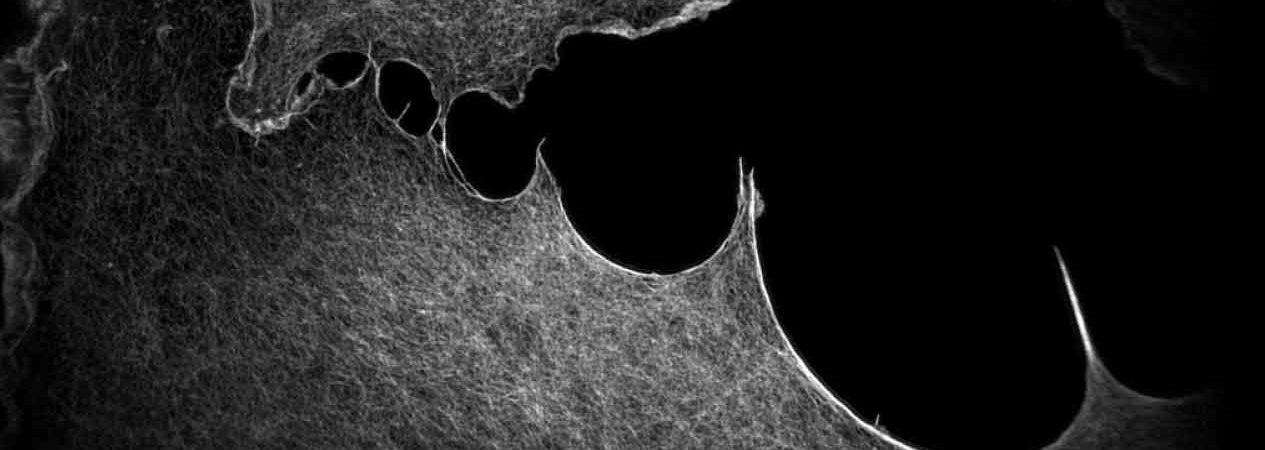
- On the CBI platform in Toulouse, led by Thomas Mangeat, Random Illumination Microscopy (RIM) was used to image basal actomyosin networks in super-resolution during Drosophila oogenesis. This approach revealed a structural reorganization of actomyosin fibers, shifting from a linear, contractile network to a discontinuous, non-linear network associated with epithelial cell expansion; uncovering mechanical properties essential to follicle cell flattening and tissue elongation. (Li, Shun, et al. “Basal actomyosin pulses expand epithelium coordinating cell flattening and tissue elongation.” Nature Communications 15.1 (2024): 3000.)
Rimeo’s development roadmap
Rimeo is actively continuing to develop its product portfolio. Two new building blocks are in preparation: DRIMflow, a graphical interface for large-scale microscopy image processing, designed for RIM but intended to eventually extend to other imaging modalities, and DRIMcraft, a software and algorithm development services offering.
On the laser side, several avenues are being explored for future versions of LiveDRIM: higher wavelengths, to gain imaging depth or reduce phototoxicity, along with ongoing discussions with Oxxius about developing laser sources specifically suited to RIM’s requirements.
Longer term, Rimeo aims to extend its reach beyond academic biology labs, with organoid screening as a priority goal for the pharmaceutical industry, along with prospects in cosmetics.


About Rimeo
Founded in 2025, Rimeo is a French deeptech start-up specializing in super-resolution microscopy. Born from academic research, the company developed RIM (Random Illumination Microscopy), commercialized through its LiveDRIM module, which turns a standard microscope into a super-resolution instrument. Rimeo primarily serves biology research labs, with ambitions to expand into the pharmaceutical industry.