
Spinning-Disk Confocal in BSL-3: How the Oxxius laser combiner Enables Long-Term Live-Cell Imaging at IMAG’IC
Monitoring in real time the interaction between HIV and opportunistic bacteria over several days, under strict biosafety conditions — this is the daily challenge tackled by spinning-disk confocal microscopy at IMAG’IC, the photonic microscopy core facility of Institut Cochin (Paris). At the heart of the BSL-3 setup: an Oxxius MixxWave L4Cc wavelength combiner delivering the laser stability that long-term live-cell imaging demands.
A critical need: long-term live-cell imaging in a BSL-3 environment
Some of the most complex diseases (HIV, viral hepatitis, SARS-CoV-2) can only be studied in BSL-3 (Biosafety Level 3) laboratories, where regulatory and technical constraints are particularly demanding. Observing living infected cells over hours or even several days without compromising image quality represents a major optical challenge.

IMAG’IC, the photonic microscopy core facility of Institut Cochin (Paris), supports around 300 users per year (academic researchers and industry professionals) across 15 acquisition systems covering all state-of-the-art modalities: confocal microscopy, super-resolution (PALM, STORM, STED), multiphotonics, TIRF (Total Internal Reflection Fluorescence), FLIM (Fluorescence Lifetime Imaging Microscopy), and flow cytometry imaging.
The facility operates across BSL-1, 2 and 3 levels, a rare capability that enables live-cell imaging of human samples infected with pathogens such as HIV, hepatitis viruses, or SARS-CoV-2..
For long-term BSL-3 experiments, the primary constraint is light source stability. Any intensity drift or spectral instability over hours or days directly compromises acquisition reproducibility and biological data interpretation. At the heart of the solution: the Oxxius MixxWave L4Cc laser combiner.
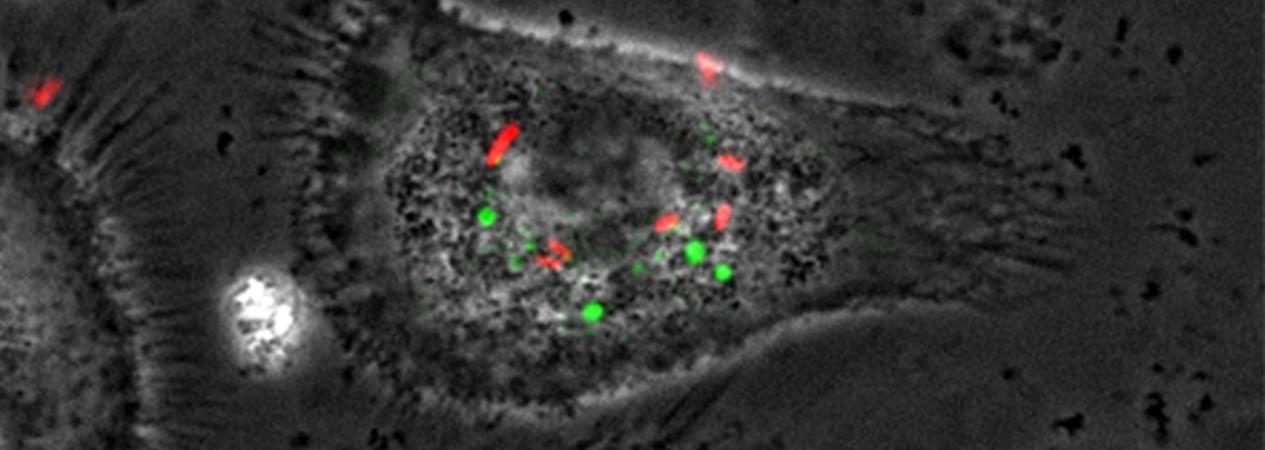
Primary human macrophages were infected for 8 days with HIV-1-GFP (green), then challenged with Salmonella Typhimurium-DsRed (red). Live imaging was performed for up to 6 hours at 37 degrees C in the BSL-3 laboratory. Macrophages are recognised as reservoirs for HIV-1, which modifies their functions and makes them less capable of clearing bacteria. This experiment studies how opportunistic bacteria take advantage of HIV-1-infected macrophages to proliferate. Credits : Gabrielle Lê-Bury & Florence Niedergang, Institut Cochin.
IMAG’IC’s spinning-disk confocal in BSL-3 setup: architecture and instrument choices
To meet its users’ needs in a BSL-3 environment, IMAG’IC has deployed an inverted microscope equipped with a Yokogawa CSU-X1 spinning-disk, enabling confocal optical sectioning at high magnification. A heating chamber and CO2 supply maintain the physiological conditions required for proper cell development during imaging. Images are acquired through either a CCD (Charge-Coupled Device) or EMCCD (Electron-Multiplying CCD) camera, depending on the desired temporal dynamics and sensitivity level. The whole system is driven by MetaMorph software.
At the heart of the excitation architecture: the Oxxius MixxWave L4Cc laser combiner, integrating 4 laser lines.
In their own words
We needed more powerful and stable light sources to ensure good performances to monitor biological events that can last several days. The Oxxius combiner gathering 4 laser lines (405, 488, 561, 638 nm) totally makes it.
Thomas Guilbert, previously Research Engineer at IMAG’IC (Institut Cochin)
Why an Oxxius laser combiner for spinning-disk confocal? Selection criteria
For long-term acquisitions in spinning-disk confocal microscopy, light source quality is non-negotiable. IMAG’IC chose the Oxxius L4Cc combiner for the following reasons:
- Stability: +/-2% power variation over 8 hours — a decisive criterion for experiments spanning several days
- Full spectral coverage: 4 laser lines (405, 488, 561, 638 nm) covering all fluorophores commonly used in cell biology
- Flexible modulation: analog and TTL (Transistor-Transistor Logic) control for precise synchronization with the camera and spinning disk
- Software compatibility: native integration with MetaMorph, uManager and LabVIEW, simplifying user onboarding
- Compact footprint: ultra-compact format, easy to integrate in a BSL-3 environment where space and access are limited
Integrating the Oxxius L4Cc into the BSL-3 spinning-disk confocal system
The MixxWave L4Cc combiner forms the excitation backbone of IMAG’IC’s BSL-3 setup. The four laser lines are combined into a single fiber output (Kineflex, polarization-maintaining fiber RGBV, FCP8 connector), with coupling efficiency above 60%. This architecture simplifies optical alignment and guarantees uniform, stable illumination regardless of acquisition session length.
Analog and TTL modulation enables precise synchronization between laser pulses and camera exposure times — a critical point for minimizing photobleaching and phototoxicity during long-term live-cell experiments.
Oxxius L4Cc configuration for the IMAG’IC spinning-disk confocal setup:
| Combiner | L4Cc MixxWave: ultra-compact, modular and upgradeable |
| Line 1 | 405 nm laser diode, 100 mW |
| Line 2 | 488 nm laser diode, 100 mW + clean-up filter |
| Line 3 | 561 nm DPSS laser, 150 mW — electromechanical shutter + AOM |
| Line 4 | 638 nm laser diode, 150 mW |
| Output fiber | Kineflex: PM fiber RGBV, FCP8 connector, coupling efficiency > 60% |
| Power stability | +/-2% over 8 hours |
| Modulation | Analog & TTL |
| Compatible software | MetaMorph, uManager, LabVIEW |
Results at the highest standards
±2%
Laser power stability over 8 hrs
the decisive criterion for long-term acquisitions
8 days
Max. live imaging duration in BSL-3
(HIV-1-infected macrophages experiment)
4 lines
405 / 488 / 561 / 638 nm
Simultaneous laser lines covering all fluorophores used in cell biology
Stable long-term acquisitions in BSL-3: robust multi-line illumination supports hours-to-days sessions without compromising confocal sectioning quality
Flexible dynamics and resolution: CCD/EMCCD selection covers slow phenotypes as well as rapid intracellular events
User autonomy and training: compact optics and software-level control reduce alignment overhead and simplify onboarding of new users
Multi-pathogen imaging under biosafety constraints: the same platform supports diverse pathogens and host-response assays under BSL-3 conditions
Outlook
The versatility of the Oxxius L4Cc combiner (modular, upgradeable and compatible with all major microscopy software) makes it a long-term solution for IMAG’IC’s evolving instrument portfolio. The platform is set to support new infectious disease research programs, while maintaining the standards of reproducibility and user autonomy that define the facility’s reputation.
The modular architecture of the L4Cc also leaves the door open for the addition of new wavelengths, depending on the needs of the research teams hosted at Institut Cochin.