
LDI-G2-4 Laser Diode Illuminator
LDI-G2-4
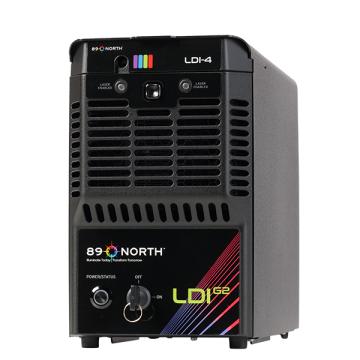
The LDI-G2-4 Laser Diode Illuminator represents a significant leap forward from the original LDI-4 platform. By adopting a single 400 µm fiber output, compared to the bifurcated configuration of Gen1, the G2 architecture concentrates the same optical power into a smaller core, delivering higher power density at the sample plane. Combined with a tenfold improvement in CW stability (< 0.2%) and intensity control down to 0.1% steps, the LDI-G2-4 sets a new benchmark for quantitative fluorescence imaging. It is fully compliant with the QUAREP-LiMi WG1 standard, making it the reference choice for reproducible, publication-grade confocal, TIRF, PALM/STORM, and live-cell imaging workflows.
Key features
- 4 laser lines covering the most widely used fluorescence probes
- Up to 1000 mW output power per line
- Feedback-controlled optical stability
- Optional 488 nm & 577 nm lasers
- No user alignment required
- TTL & Analog control

References and product variations
Part number
Combined wavelengths (nm)
Options
Ask for a quote
Part number LDI-G2-4
Part number LDI-G2-4-577
Part number LDI-G2-4-488
Part number LDI-G2-4-488-577
Performance by Wavelength
Wavelength
Optical Power Min (1)
CW Stability (typ.) (2)
Max Rise Time (typ.) (3)
Max On/Off Frequency (4)
405
Optical Power Min (1) 300 mW
CW Stability (typ.) (2) <0.2 %
Max Rise Time (typ.) (3) <5 µs
Max On/Off Frequency (4) >1000 Hz
470 or 488
Optical Power Min (1) 1000 mW (5)
CW Stability (typ.) (2) <0.2 %
Max Rise Time (typ.) (3) <5 µs
Max On/Off Frequency (4) >1000 Hz
555 or 577
Optical Power Min (1) 700 or 500 mW (6)
CW Stability (typ.) (2) <0.2 %
Max Rise Time (typ.) (3) <2 ms
Max On/Off Frequency (4) 100 Hz
640
Optical Power Min (1) 400 mW
CW Stability (typ.) (2) <0.2 %
Max Rise Time (typ.) (3) <5 µs
Max On/Off Frequency (4) >1000 Hz
(1) Defined in accordance with the QUAREP-LiMi WG 1 standard, “Illumination Power, Stability, and Linearity Measurements for Confocal and Widefield Microscopes V.2”, Section 8, with power output measured at the fiber output.
(2) Measured at 100 % intensity, 23 °C ± 2 °C.
(3) Defined in accordance with the QUAREP-LiMi WG 1 standard, “Illumination Power, Stability, and Linearity Measurements for Confocal and Widefield Microscopes V.2”, Section 8, with power output measured at the fiber output.
(4) Measured at 100 % intensity, 50 % duty cycle
(5) 470 or 488 - Optical Power Min: 488 nm optical power min preliminary estimate. Actual output power pending product release.
(6) 555 or 577 - Optical Power Min: 577 nm optical power min preliminary estimate. Actual output power pending product release.
Optical characteristics
Output Power
Up to 1000 mW per line
+ higher power density via 400 µm
single fiber
Optical Stability
Active feedback control
< 0.2 % CW stability (10× improvement)
Intensity Control
0.1 % steps (10× finer)
Full linear range
Laser Lines
Up to 7 lines: 405 / 445 / 470 or 488
520 / 555 or 577 / 640 / 730 nm
NIR Channel (730 nm)
✔ Deep-tissue imaging
Extended spectral range beyond visible
Beam Quality
Improved beam quality
Cleaner, more stable output profile
Fiber Output
400 µm single → higher power
density
User Alignment
Not required
LDI-G2-4 Laser Diode Illuminator General specifications
Output Options
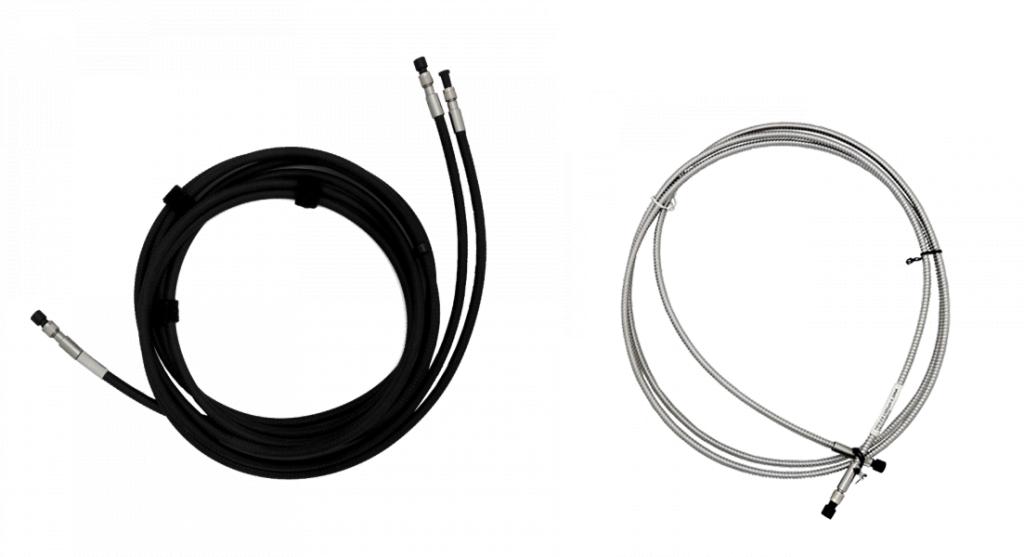
Optical fiber
(400 µm single, 0.39 NA)
Control Options
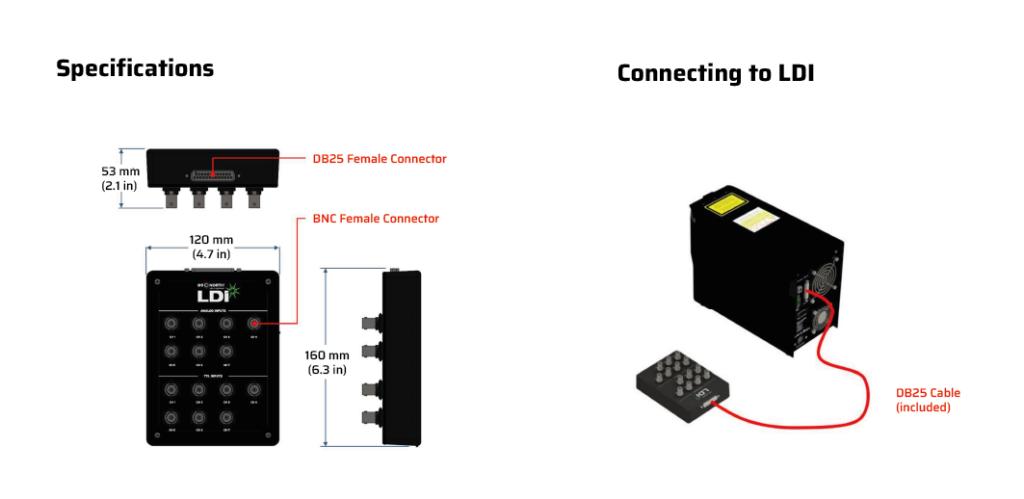
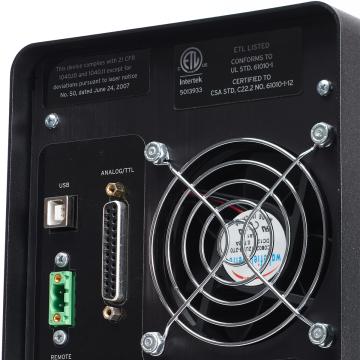
TTL (> 2.3 V) | Analog (0–5 V)
USB–DSP (virtual COM port)
Safety
Interlocked housing | Key interlock
IEC 60825 compliant
QUAREP-LiMi WG1
✔ Compliant
Dimensions
318 × 234 × 146 mm
(12.5" × 9.2" × 5.75")
Weight
~4 kg (~9 lbs)
Operating Temp.
15 to 30 °C
Storage Temp.
-18 to 50 °C
Humidity
<80 % non-condensing
Voltage
90–220 V AC, 50–60 Hz
Warranty
2 years
Applications / Techniques
Spinning Disk Microscopy
Widefield Microscopy
Light Sheet Microscopy
Structured Illumination Microscopy (SIM)
Super Resolution Imaging
TIRF
PALM / STORM / DNA-PAINT
FRAP
Photoactivation / Photoconversion
Photoablation
Optogenetics
Neuroscience / Physiology
Cellular Biology
Single Molecule FISH (smFISH)
Spatial Transcriptomics / Proteomics
Digital Pathology