

Underwater LiDAR for Deep-Sea Exploration: Inside Oxxius’s Role in the ID-GF Project
Underwater LiDAR for deep-sea exploration is no longer a distant ambition, the ID-GF project is making it a reality. Developed by a five-partner French consortium including Oxxius, ENSTA Bretagne, Ifremer, FMC Composites and HEXA-H, and funded under the France 2030 Plan, ID-GF deploys a distributed swarm of networked hybrid underwater floats equipped with laser-based LiDAR imaging and optical communication systems. Oxxius supplies the laser subsystems at the heart of each float.

The ID-GF project (Imageur Distribué Grands Fonds: Deep-Sea Distributed Imager) draws on the expertise of three specialized SMEs (FMC Composites, Oxxius and HEXA-H) and two renowned maritime-science research institutions, ENSTA Bretagne and Ifremer.
The goal is to develop and integrate technological building blocks in order to deploy a system made up of a large distributed array formed by a swarm of hybrid floats, all networked and geolocated from the surface. Oxxius will supply several of these building blocks, including the LiDAR subsystem, underwater optical communications, and the integration of these subsystems inside the floats.
The potential applications are numerous: physical (turbulence, internal waves) and biological (marine-mammal localization, fisheries resources) oceanographic studies (as well as the coupling between them) monitoring of infrastructure and maritime traffic, tracking chemical pollution, and defense uses such as creating ultra-low-frequency antenna arrays.
From LAMPARO to ID-GF: Oxxius’s Expertise in Underwater Laser Systems
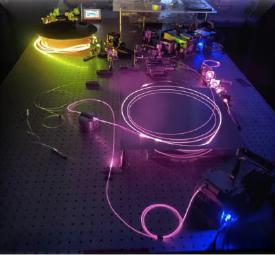
ID-GF is the third project involving underwater drone communication in which Oxxius has taken part. The first two were the DGA/RAPID projects LAMPARO and then CHIMAERA. In those programs, Oxxius was responsible for the complete transmit-and-receive modules, including lasers, detectors and boards. A specialist in lasers (especially diode lasers) and laser-based subsystems, Oxxius is contributing its expertise here to implement and integrate the application-specific laser within the underwater float.


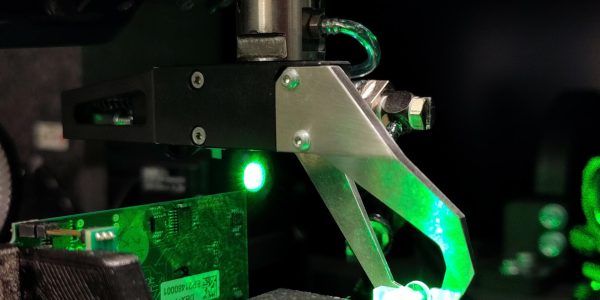
Tests conducted to validate the basic building blocks of underwater communication and LiDAR. Tests carried out in March 2026 in the ENSTA Bretagne swimming pool, in the presence of the partners. Photo credits: Oxxius.
France 2030 Funding: Accelerating Underwater LiDAR Technology in France