
MixxWave High Power Laser Combiner
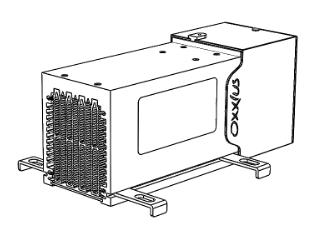
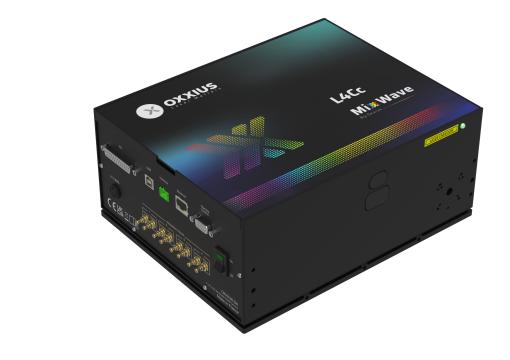
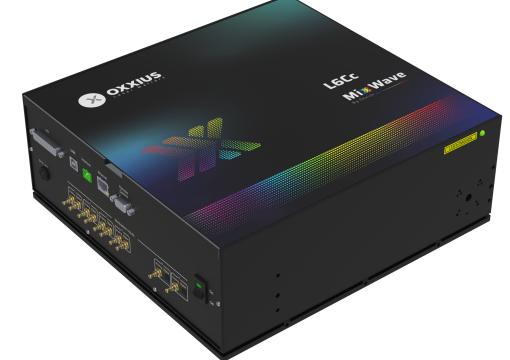
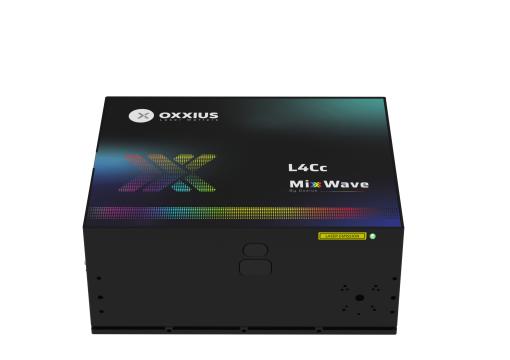
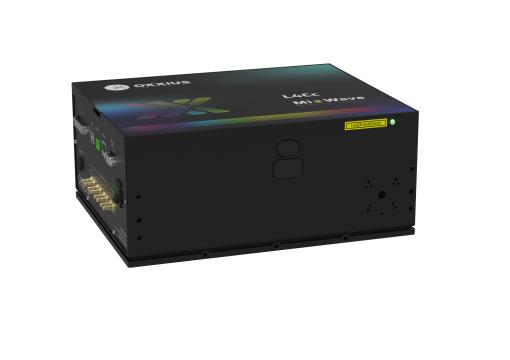
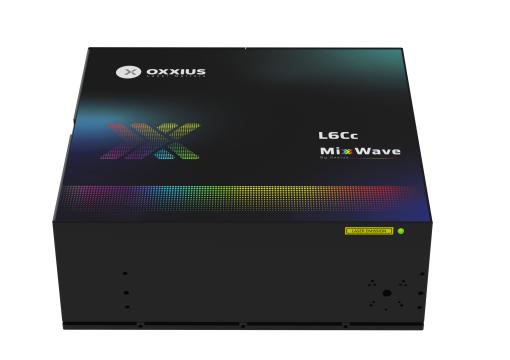
The Oxxius MixxWave high power laser combiner merges multiple high-power laser diodes — from 375 nm to 1064 nm, with individual outputs up to 1400 mW — into a single multimode fiber output. Available in two configurations, the L4Cc (up to 4 lasers) and the L6Cc (up to 6 lasers), it is built for demanding applications such as materials processing, spray measurement, and high-irradiance illumination, where both high optical power and a compact, thermally stable platform are required.
Key features
• L4Cc: up to 4 lasers, 2 AOMs • L6Cc: up to 6 lasers, 2 AOMs
• Combines 375–1064 nm wavelengths
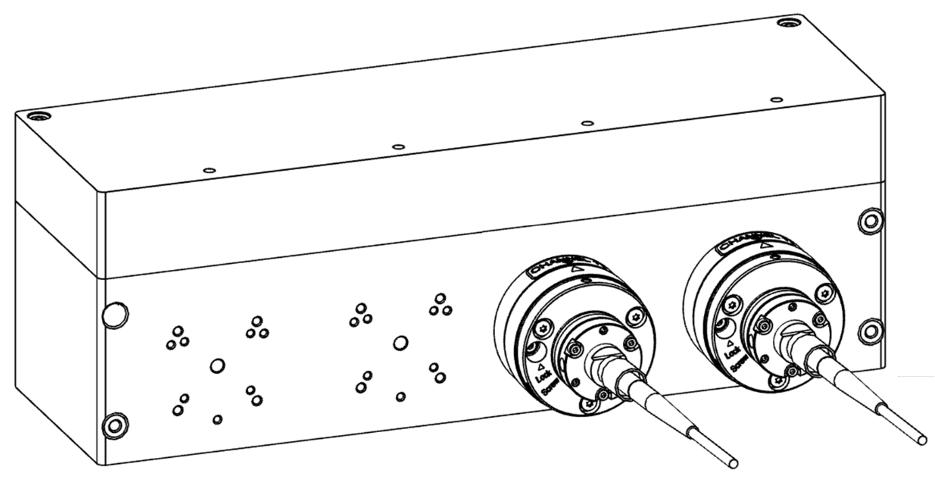
• Up to 2 fiber outputs
• Integrated electro-mechanical shutters on each port
• Extension modules for port switching

General specifications
Free space
±1 % p-to-p
PM + SM fiber coupled
±2 % p-to-p
Analog (0 - 5 V)
DC - 1 MHz
Rising time using digital modulation (TTL)
≤ 2 ns (LBX) / ≤ 150 ns (LCX with AOM)
Power extinction ratio
Infinite (LBX) / ≥ 40 dB (LCX with AOM)
Operating temperature
15°C to 40°C at baseplate
Supply voltage, standard Plug and Play version
100 - 240 V AC
Supply voltage, OEM version
24 V DC
Warm-up time
30 minutes
Communication interfaces
USB, Ethernet, dedicated electrical interface
Software
Full access from µManager, dedicated Oxxius software
Typical weight
L4Cc: 7 to 9 kg L6Cc: 10 to 12 kg
Warranty
24 months
MixxWave Configurations: CW & Modulated, High Power, or Single Frequency?
Oxxius offers the MixxWave combiner in three configurations to match different source types:
- The CW & Modulated version is suited for general-purpose multi-wavelength imaging and spectroscopy requiring fine modulation control.
- The High Power version, covered on this page, is built for applications demanding higher optical power per channel, delivered through a multimode fiber.
- The Single Frequency version is optimized for narrow-linewidth sources used in coherence-sensitive measurement applications.
Applications
The MixxWave high power laser combiner is used in applications requiring high optical power delivered through a single aligned fiber output, including spray measurement, materials processing, and high-irradiance illumination for industrial and research instrumentation.
Why Choose the Oxxius High Power MixxWave?
Manufactured in France with full vertical integration, the Oxxius high power MixxWave combines high-power laser diodes, thermal stability, and a compact mechanical design engineered for demanding OEM and industrial environments. Every combiner is factory-aligned and validated for long-term reliability, backed by a 24-month warranty.
Need help?
Frequently Asked Questions
Choosing a multicolor laser combiner involves a range of technical decisions: from the number of wavelengths and source types to modulation modes, fiber outputs, and software integration. The questions below address the most common topics raised by researchers, system integrators, and OEM partners when specifying a MixxWave L4Cc or L6Cc. If your question is not covered here, our team is available to help you define the right configuration for your application.