
Laser Nanoparticle Characterization: Oxxius LBX-445 Enables UNVEIL to Detect 20 nm Nanoparticles
Detecting and characterizing individual 20 nm nanoparticles in 10 minutes, with a single sample droplet and no labeling: that is the challenge UNVEIL has met through cutting-edge laser nanoparticle characterization, powered by an Oxxius laser at the heart of an interferometric microscope built around an ultra-high-precision optical architecture.
A critical need in biopharmaceutical development
Biopharmaceuticals are a recent generation of drugs whose active substance is produced from living cells, unlike conventional chemical drugs. Made famous by mRNA vaccines against Covid-19, they have established themselves as one of the most promising therapeutic approaches for hard-to-treat diseases such as certain cancers and autoimmune conditions.
A growing share of them rely on a common principle: encapsulating an active component (RNA or DNA) inside a vector — typically a virus or a lipid nanoparticle — to deliver it to the right location in the human body.
The question then becomes critical: how many of these vectors are actually loaded? An empty vector has no therapeutic effect and can trigger unwanted immune responses in the patient. Verifying this empty/full capsid ratio is therefore a mandatory step in quality control, both for pharmaceutical companies and for research.
Established technologies such as DLS or NTA lack the sensitivity to detect particles this small. Alternative techniques such as AUC do answer the question, but require around twenty hours per measurement — incompatible with the pace of R&D and production.

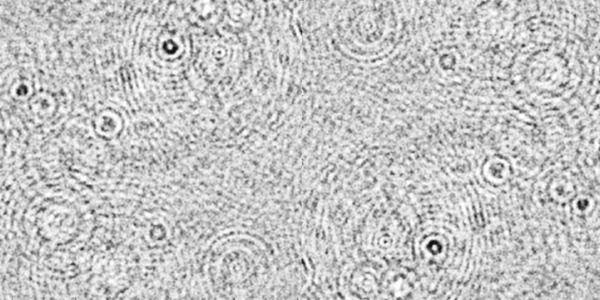
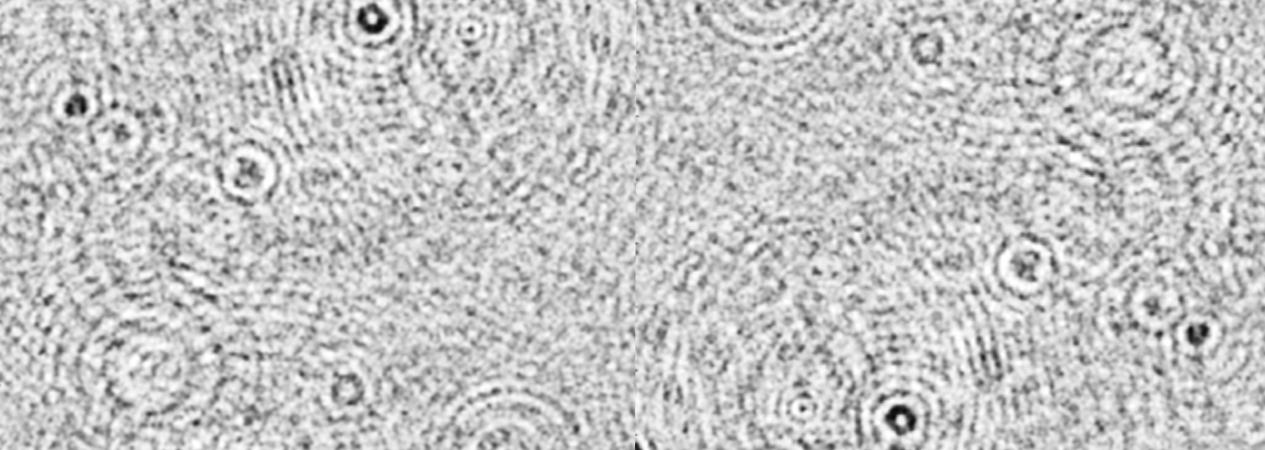
Laser particle characterization at the nanoscale: individual 20 nm nanoparticles detected and characterized in their native state by UNVEIL’s LIGHTWEIGH interferometric microscope, powered by the Oxxius LBX-445 laser — no fluorescent labeling required.
UNVEIL’s answer: the LIGHTWEIGH, an ultra-sensitive interferometric microscope
Founded in 2024 as a spinoff from the Institut d’Optique, UNVEIL develops the LIGHTWEIGH, an interferometric microscope capable of detecting individual nanoparticles down to 20 nm in diameter. Its technology is based on the principle of light interference: the laser illuminates the nanoparticles, and a tiny fraction of the beam — reflected at the interface between the coverslip and the sample (approximately ½ %) — interferes with the light scattered by each particle. Thanks to this interferometric gain of a factor of 10,000, the LIGHTWEIGH detects nanoparticles that conventional instruments simply cannot see.
It then estimates the mass of each vector from the light it scatters. This light signal is what makes it possible to distinguish a full vector from an empty one.


The microscope simultaneously measures the absolute concentration, individual mass, and hydrodynamic size of each nanoparticle ; all without any sample labeling. Unlike conventional technologies that require attaching fluorescent molecules to particles to make them visible (a time-consuming, costly step that can alter their natural behavior), the LIGHTWEIGH detects nanoparticles in their native state. A single droplet of sample is all that is needed, with no prior preparation.
At the heart of this ultra-high-precision optical architecture: an Oxxius LBX-445 laser (445 nm).
On the above mass histogram generated by the LIGHTWEIGH, full and empty vectors are distinguished at a glance. The sensitivity of the optical setup, made possible by the Oxxius LBX-445 laser, enables precise laser particle characterization — each particle weighed individually, in its native state.
In their own words
The laser is the starting point and the most critical component of our entire optical setup. Detecting objects at 20 nanometers demands absolute precision: the slightest degradation in wavefront quality and the measurement no longer works.
Alexis Auchère, CEO, UNVEIL
Finding the right laser source: a requirement for perfection
In an interferometric microscope, the laser is far more than a light source: it is the most critical component of the entire optical setup. The requirements were therefore precise:
- Wavelength between 420 and 450 nm (445 nm), suited to the interferometric technique
- High spatial coherence and the lowest possible temporal coherence
- Impeccable stability and low noise: any variation, however small, compromises the measurement
- Fiber-coupled output, as the starting point of the instrument’s optical path
- Minimum output power of 300 mW at the fiber output
- Impeccable wavefront quality (single-mode fiber coupling)
- Fast modulation: switching synchronized with camera exposure times
- Easy integration and long-term robustness
- French manufacturing
Oxxius laser trusted by Unveil’s technical team
Oxxius enables us to integrate 445 nm lasers into our instruments delivering up to 350 mW at the single-mode fiber output — a rare performance on the market. Reliable, straightforward to integrate — truly plug-and-play — and backed by excellent technical support, these lasers save us valuable time during instrument development.
Matthieu Greffet, CTO, UNVEIL
Why an Oxxius laser?
UNVEIL’s technology was initially developed at the Institut d’Optique, where several laser sources were evaluated — first in the green, then ultimately in the blue. The Oxxius FlexxRay LBX-445 laser came out on top across all technical criteria, and this same model was selected for the industrialized version of the LIGHTWEIGH.
Several factors reinforced this choice:

- Technical: 445 nm wavelength, impeccable coherence and stability, fiber-coupled output ready for integration — with no custom development required
- Availability: a catalog product requiring no customization, a decisive advantage for a startup looking to control costs and lead times
- Customer support: responsive exchanges with Oxxius teams, including on highly specific questions related to operating conditions during customer demonstrations
- Partnership: a relationship of trust with a human-scale company, capable of prioritizing requests from an innovative startup
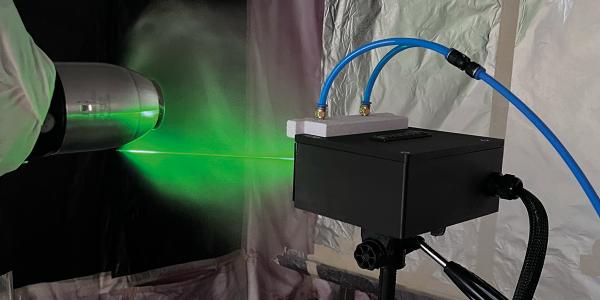
Oxxius FlexxRay LBX-445 laser integrated into the Lightweigh for laser nanoparticle characterization
Integrating the Oxxius LBX-445 Laser into the LIGHTWEIGH
The fiber-coupled Oxxius FlexxRay LBX-445 laser forms the foundational building block of the optical path. The blue beam is then further conditioned to meet the demands of an exacting interferometric microscope: coherence, alignment, and stability throughout the measurement session. The instrument generates 1,000 3D snapshots per second, in which each nanoparticle is individually detected, tracked, and characterized.
Since the LIGHTWEIGH is compact and designed to be transported to customer sites, the laser’s small footprint and robustness during transport and real-world operating conditions were also decisive criteria.
Results: unprecedented measurements in a fraction of the time
20 nm
Individual nanoparticle detection
10 min
vs. hours
Measurement duration
5 µL
vs. 250 mL
Sample volume
20 nm — individual nanoparticle detection: the LIGHTWEIGH identifies and measures individual nanoparticles down to 20 nm in diameter — 4,000 times smaller than a human hair. At this scale, conventional instruments such as DLS or NTA simply see nothing. Thanks to the interferometric gain provided by the Oxxius laser, each particle is characterized in its native state.
10 min vs. hours — measurement duration: the LIGHTWEIGH measures in 10 minutes quantities that were previously inaccessible: empty/full capsid ratio, absolute concentration, individual mass, and hydrodynamic size of nanoparticles.
5 µL vs. 250 mL — sample volume: legacy techniques such as AUC require around twenty hours of measurement and up to 250 mL of sample — the equivalent of a glass of water. The LIGHTWEIGH requires only 5 µL, a single droplet, 50,000 times less. For biopharmaceuticals that are often available in very limited quantities and at high cost, this difference is considerable.
Finally, whereas established technologies require “labeling” the sample by attaching fluorescent molecules to it, the LIGHTWEIGH detects particles without altering their composition or behavior. This label-free approach significantly reduces the time and cost of each measurement.
UNVEIL Outlook
UNVEIL is currently in the industrialization phase of the LIGHTWEIGH, with several units deployed in France and ongoing discussions internationally.
For this large-scale deployment stage, UNVEIL has chosen to retain the Oxxius LBX-445 laser, a decision that reflects the confidence placed in the source’s performance and reliability.
Looking further ahead, the evolution of the LIGHTWEIGH toward multi-wavelength fluorescence capabilities could open the door to integrating new laser sources, potentially including other models from the Oxxius product range.