
Neuropixels Opto: A New Probe Combining High-Density Recording and On-Chip Optogenetics
A team spanning University College London, the Allen Institute, the University of Washington and HHMI has published a major advance in neuroscience tools in Nature Methods: Neuropixels Opto, a prototype probe that integrates high-density electrical recording with on-chip photonic light delivery for optogenetics, all on a single 70-µm-wide shank.
The challenge
Understanding how the brain works requires recording the activity of many neurons at once while also being able to switch specific, genetically defined cell types on or off with light: a combination known as opto-electrophysiology. Doing both at once, with the spatial precision needed to target individual cortical layers or nearby cell populations, has long been limited by the light sources and delivery methods available: fiber-based systems offer few emission points, and micro-LEDs generate heat that can distort the very signals researchers are trying to measure.
The method
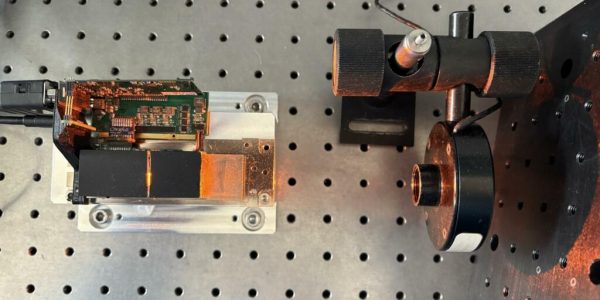
The Neuropixels Opto probe solves the delivery problem with an integrated photonics layer that routes external laser light down the shank to 28 individually addressable emitters, enabling dual-color (blue and red) optogenetic stimulation alongside 960 high-density recording sites. Across the study’s in vivo experiments, the team relied on stable, low-noise laser sources to drive this system reliably:
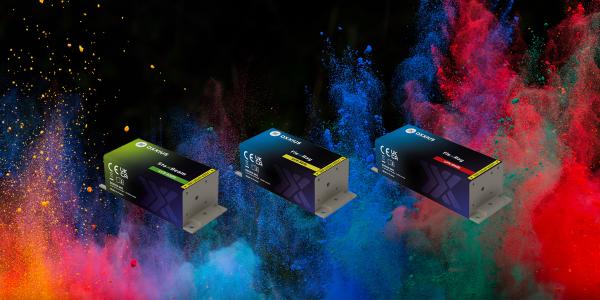
• For spatially resolved activation and inactivation of local cortical circuits, the team used, in two of the three mice tested, an Oxxius LBX-638nm diode laser to deliver red light pulses to specific emitters on the probe.
• For dual-color optotagging experiments identifying genetically defined neuron types in the striatum and midbrain, light was delivered either through the PXI-mounted laser module or through a two-channel Oxxius laser combiner.
The result
Using this setup, the researchers demonstrated spatially addressable optogenetic activation and inactivation of neurons at distinct cortical depths, and successfully optotagged 261 individual units across 40 recording sessions in 26 mice, identifying two genetically defined cell types in parallel. The probe combined recording quality comparable to the widely used Neuropixels 1.0 and 2.0 systems with fine spatial control over optogenetic stimulation, a combination the authors describe as an essential tool for high-density recording with local optogenetic activation or inactivation and for cell-type-specific electrophysiology across the brain.
Why it matters for researchers
This study is a strong example of what stable, low-noise, precisely controlled laser sources make possible in demanding in vivo neuroscience: reliable optogenetic stimulation with minimal light-induced recording artifacts, even at the tight timescales and small light budgets required by on-chip photonic delivery. It’s exactly the kind of application Oxxius lasers (including the LaserBoxx (LBX) diode series and multi-wavelength combiner modules) are built for.


Source:
- Lakunina, A.A., Socha, K.Z., Ladd, A.E. et al. Neuropixels Opto: combining high-resolution electrophysiology and optogenetics.
- Nat Methods 23, 1207–1216 (2026).
- Read the full article: https://doi.org/10.1038/s41592-026-03076-z