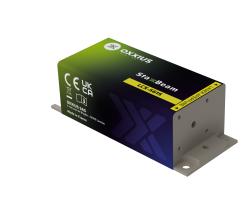


Laser Doppler Velocimetry (LDV)
Laser-based anemometers measure the velocity and direction of a fluid remotely, without disturbing its flow, Oxxius lasers provide the powerful, stable beams required for such precise measurements in industrial environments.
Principles of Laser Doppler Velocimetry
At the location of interest, interference fringes are formed within a measurement volume. A particle crossing these fringes scatters light alternately from bright and dark regions. This flickering signal is collected by a probe head and processed to extract the particle’s velocity. Multiple fringe patterns are required to compute the full velocity vector within the measurement volume. Repeating this measurement at various positions within the flow allows for the reconstruction of a complete velocity map.

Laser requirements & multi-laser configurations
Why are lasers crucial for LDV?
Stable interference fringes generated several decimeters away from the illumination head require a source with a coherence length of at least a few millimeters: a property only lasers can provide. In addition, LDV performance critically depends on several characteristics of the illumination laser:
- Sufficient and stable optical power: The scattered light from particles must be clearly distinguishable from background noise. The laser output must therefore be powerful, low-noise, and stable throughout the measurement.
- High beam quality: A low beam quality factor enables the formation of a small, sharply defined measurement volume. Minimizing beam pointing variations with temperature is equally important.
- Narrow and clean spectral line: A narrow linewidth and the absence of strong secondary peaks ensure high-contrast fringe patterns. Mode hops are particularly detrimental, as they induce noise in the illumination signal.
- Appropriate wavelength selection for multi-laser systems: In 2D and 3D LDV setups, several lasers of different wavelengths are used. These wavelengths must be separated enough to prevent crosstalk, yet close enough to limit chromatic dispersion in the collected signal.
- Robust environmental performance: The laser must operate reliably in non–temperature-controlled environments.
- Efficient fiber injection when needed: In some setups, each laser beam must be injected into an optical fiber to reach the measurement location. At the output, the beam must remain stable with a well-defined polarization state and a high PER.
In practice, the choice of laser sources depends on the complexity of the system (1D, 2D or 3D) and on the velocity and geometry of the flow to be characterized.
Oxxius DPSS single-frequency lasers
Why choose Oxxius lasers for LDV?
Oxxius has developed a unique monolithic cavity technology, protected by more than ten patents, that sets our DPSS lasers apart.
- Up to 800 mW in a TEM₀₀ beam with a beam quality factor < 1.1, enabling a small and well-defined interference volume
- High spectral purity: Our resonator design ensures a spectrum free of detrimental side peaks and provides meter-scale coherence lengths for stable, high-contrast fringes
- Ultra-stable output: Emission is free from mode hops
- Choice of three wavelengths: 532 nm, 553 nm, and 561 nm (additional wavelengths available on request)
- Exceptional robustness: Thanks to the monolithic design, the lasers remain stable over operating temperatures from 10 °C to 50 °C
- Optional fiber-coupling module: Guarantees > 70% coupling efficiency into a polarization-maintaining fiber
Together, these features ensure that Oxxius DPSS lasers deliver the power, stability, and precision required for high-performance LDV.
532 nm narrow-linewidth DPSS laser
Featured product for Raman spectroscopy: LCX-532S

- Wavelength : 532.3 nm
- Output power up to 800 mW (continuous wave)
- Coherence length > 300 m
- Beam quality factor < 1.1
- Operating temperature from 10°C to 50°C
- Power stability < ± 1.0%
The LCX-532S is thus ideally suited for Laser Doppler Velocimetry, offering exceptional precision and stability.
LDV wavelength portfolio
Related products
- LPX-561S – Single-frequency laser delivering up to 500 mW at 561 nm in TEM₀₀
- LPX-553S – Single-frequency laser delivering up to 300 mW at 553 nm in TEM₀₀
- L1C-MPA – Power adjustment module with minimal impact on signal quality


With Oxxius StaxxBeam DPSS lasers, you can rely on a robust, high-quality source delivering powerful, stable output ; the foundation of precise and reliable Laser Doppler Velocimetry.