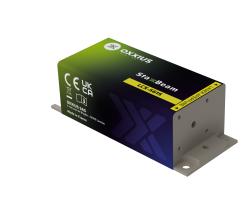


Filtered Rayleigh Scattering (FRS)
Filtered Rayleigh Scattering (FRS) is a technique used to remotely measure the thermodynamic properties of a gas flow, particularly in situations where seeding is not feasible. Oxxius lasers provide the powerful and precise excitation required for this advanced diagnostic method.
Principles of FRS
What is Filtered Rayleigh Scattering?
When light interacts with gas molecules, it is scattered according to Rayleigh scattering. Due to molecular motion within the gas, the scattered light exhibits a spectral broadening relative to the incident light. By collecting this scattered light and analyzing the spectral broadening, it is possible to determine the temperature or pressure of the gas under investigation. Additionally, any wavelength shift in the collected spectrum provides information about the bulk velocity of the flow.
Achieving these measurements requires highly selective filtering in the detection path to reject stray light and minimize background noise
Laser requirements
What light sources are suited for Filtered Rayleigh Scattering?
FRS demands an excitation source with high power and a spectral linewidth significantly narrower than the expected broadening of the scattered light. For this reason, single-frequency lasers are the standard for FRS, as they meet the following key criteria:
- High output power to illuminate a sufficiently large region of the gas flow
- True single-frequency operation, free from secondary peaks that could interfere with the Rayleigh–Brillouin spectrum
- Narrow emission linewidth, enabling the detection of broadenings on the order of a few gigahertz
- Excellent wavelength stability to ensure accurate measurement of wavelength shifts
- Fine wavelength tuning to precisely match the excitation wavelength to the filter’s transmission bandwidth
The choice of laser source also depends on the availability of appropriate filters, typically gas cells.
Oxxius DPSS single-frequency lasers
Why choose Oxxius lasers for Filtered Rayleigh Scattering?
Oxxius has developed a proprietary monolithic resonator technology—protected by more than ten patents, that distinguishes its DPSS lasers in the marketplace.
- High spectral purity: The resonator design guarantees a spectrum free from detrimental side peaks, with a side-mode suppression ratio exceeding 110 dB over a 100-GHz span around the main peak (see spectrum below).
- Ultra-stable single-frequency operation: Oxxius lasers maintain wavelength stability within 1 pm.
- Exceptional robustness: Designed to withstand significant thermal and mechanical variations, these lasers operate reliably from 10°C to 50°C.
- Ultra-narrow linewidth of 1 MHz: Sufficiently narrow for accurate measurement of the broadened scattered spectrum.
- TEM₀₀ beam quality enabling diffraction-limited measurement volumes, whether pointwise or planar.
Together, these features ensure the reliability, precision, and reproducibility essential for FRS.

Spectrum of the LCX-532S-200 over a 100-GHz span. The intensity of the of side peaks is expressed relative to the elastic peak at the center. Data measured in collaboration with TableStable Ltd.
532 nm narrow-linewidth DPSS laser
Featured product for FRS: LCX-532S

- Wavelength : 532.3 nm
- Output power up to 800 mW
- Spectral linewidth < 1 MHz
- Wavelength stability < 4 pm (0.14 cm-1)
- Power stability < ± 1.0%
- Optional power adjustment feature that preserves all spectral properties
The LCX-532S is ideally suited for FRS, delivering exceptional signal-to-noise ratio and long-term stability.
Other sources
Related products
- FC-PM – Injection module for delivering optical power through a polarization-maintaining fiber
- HTSK-1 – Silent heatsink enabling laser operation in environments up to 35°C
- L1C-MPA – Variable attenuator that preserves the laser’s spectral characterstics

With Oxxius DPSS lasers, you benefit from unmatched wavelength stability, spectral purity and robustness, essential qualities for high-performance Filtered Rayleigh scattering.