
Brillouin Spectroscopy
Brillouin spectroscopy uses laser light to quantify the mechanical properties of a medium. Oxxius lasers make this delicate measurement possible.
Principles of Brillouin scattering
What is Brillouin Spectroscopy?
The Brillouin effect is an inelastic interaction between light and matter. During this process, an incident photon exchanges energy with the acoustic vibrations present in the material, producing a wavelength shift on the order of a few picometers. The collected spectrum provides quantitative information about the acoustic velocity within the medium, which in turn reveals its longitudinal modulus and viscosity.
Brillouin spectroscopy is therefore a non-destructive, label-free, and contact-free technique for measuring the elastic and viscous properties of a sample. It is used in materials science to quantify strain and elasticity and, more recently, in the life sciences to investigate organ morphogenesis.
A powerful extension of the technique is Brillouin imaging, which consists of acquiring spectra at multiple positions within a sample to generate a map of its mechanical properties with micrometer-scale resolution.

Laser linewidth and stability
What light sources are suitable for Brillouin spectroscopy?
To efficiently induce the Brillouin effect, the excitation source must have a very narrow spectrum and high optical power. Single-frequency lasers are the only sources suitable for Brillouin spectroscopy, as they meet several essential criteria:
- True single-frequency operation, free of secondary peaks or artefacts that could overlap with the Brillouin spectrum. Optimal visibility of the Brillouin peaks requires a side-mode suppression ratio (SMSR) above 60 dB.
- Extremely narrow emission linewidth, enabling measurement of Brillouin linewidths down to ~10 MHz.
- Excellent wavelength stability, ensuring the reliability and consistency of the filtering stage.
The choice of the optimal laser source also depends on factors such as the optical properties of the sample (absorption at the excitation wavelength, phototoxicity), detector sensitivity, and other practical considerations.
Oxxius DPSS Single-Frequency lasers
Why choose Oxxius lasers for Brillouin spectroscopy?
Oxxius has developed a unique monolithic resonator technology, protected by more than ten patents, that distinguishes our DPSS lasers in the marketplace.
- Highly pure spectrum: The resonator design eliminates detrimental side peaks, delivering an SMSR above 110 dB over a 100-GHz span around the main peak (see example spectrum below).
- Ultra-stable single-frequency operation: Our lasers maintain wavelength stability within 1 pm, ensuring repeatability even from cold starts.
- Exceptional robustness: With no moving parts or adhesives, the lasers are engineered to withstand significant thermal and mechanical variations.
- Ultra-narrow linewidth (<1 MHz): Suitable for accurately resolving Brillouin peak linewidths.
- TEM₀₀ beam quality: Ensures diffraction-limited performance for imaging applications.
- Polarization extinction ratio >20 dB: Critical for effective separation of excitation and Brillouin signals.
Together, these features ensure the reliability, precision, and reproducibility required for demanding Brillouin spectroscopy and imaging applications.

Spectrum of the LCX-532S-200 over a 100-GHz span. The intensity of the secondary peaks is expressed relative to the elastic peak at the center. Data measured in collaboration with TableStable Ltd.
532 nm narrow-linewidth DPSS laser
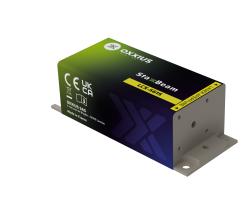
Featured product for Brillouin Spectroscopy: LCX-532S
- Wavelength : 532.3 nm
- Output power up to 300 mW
- Spectral linewidth < 1 MHz
- Wavelength stability < 1 pm (0.035 cm-1)
- Power stability < ± 0.5%
- Optional power adjustment allowing optical tuning without degrading spectral properties

The single-frequency LCX-532S laser is ideally suited for Brillouin spectroscopy, delivering unmatched signal-to-noise ratio and long-term stability.
Other laser sources
Related products
- LCX-561S – Narrow linewidth laser at 561nm for Brillouin spectroscopy and/or Raman spectroscopy
- HTSK-1 – Silent heatsink enabling laser operation in environments up to 35 °C
- L1C-MPA – Variable attenuator that preserves the laser’s spectral properties


With Oxxius DPSS lasers, you can rely on exceptional wavelength stability, spectral purity, and robustness, the foundation of high-precision Brillouin spectroscopy.