
FEM2BIO – Advancing Fluorescence Microscopy
Multicolor imaging for live-cell analysis and pathology research, including cancer
FEM2BIO (Extended Fiber for Multicolor Microscopy in Biology) is an innovative collaborative project developed in partnership with leading photonics companies—Photonics Bretagne and IDIL—and the University of Rennes (IGDR). The project focuses on advancing fluorescence microscopy to improve the analysis of biological pathologies, particularly cancer, and to support the development of targeted therapies.
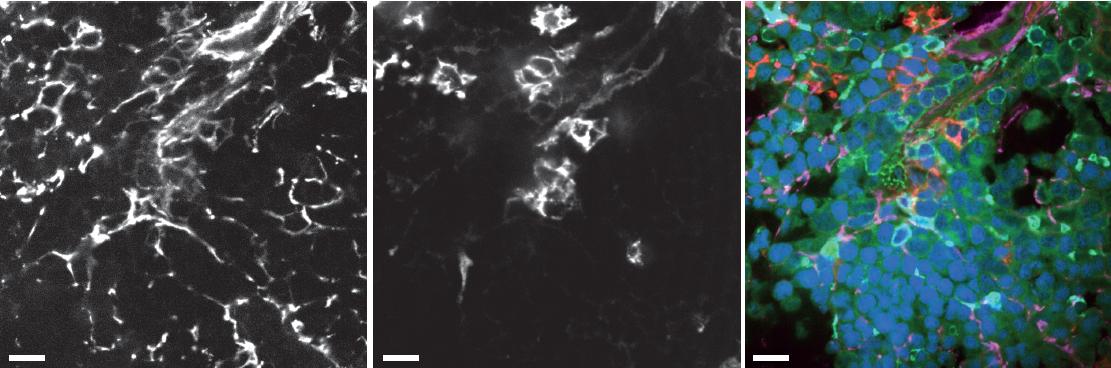
Understanding complex cellular mechanisms requires the ability to observe the dynamic interactions of multiple proteins within living organisms. Fluorescent proteins are essential tools for labeling and tracking proteins of interest in real time. Thanks to its minimally invasive nature, fluorescence microscopy enables researchers to visualize and monitor these labeled proteins directly in living samples.
Project Objectives
The main objective of FEM2BIO is to develop a high-performance video microscopy system capable of simultaneously tracking five different proteins, providing deeper insight into cellular processes and improving biological models.
Technical Development
The first phase of the project focuses on the development of advanced optical components and laser sources. A key goal is to deliver a laser combiner to IGDR that enables fluorescence microscopy using five excitation wavelengths, compared to the four currently available. Adding an extra wavelength allows researchers to monitor an additional protein, significantly enhancing data quality and computational modeling.
The second phase is more exploratory and aims to develop:
- A broadband optical fiber covering wavelengths from 320 to 900 nm
- New near-UV laser sources
To support future generations of even more powerful microscopes—capable of tracking six to eight proteins simultaneously—the project will also develop new optical technologies, including advanced fibers, laser sources, broadband laser combination using photonic crystal fibers (PCF), and dichroic filters for efficient separation of excitation and fluorescence signals.
Oxxius Contributions

A major R&D challenge for Oxxius is the development of a 698 nm laser delivering 100 mW, based on the same proven technology as the LPX-640 and the near-UV lasers previously developed by the company.
In a second step, the Oxxius team will design and build a laser combiner tailored to IGDR’s specific requirements and integrate the new 698 nm laser into the system.
Partner Contributions
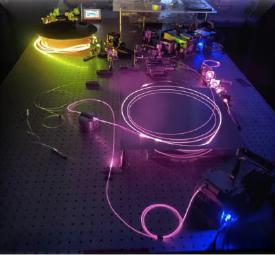
Photonics Bretagne is responsible for developing a microstructured optical fiber covering the 400–800 nm spectral range. Fiber connectorization is carried out by IDIL, using a specialized process that differs from standard Oxxius fibers. Due to the presence of air holes in the microstructured fiber, a silica endcap rod must be added at each end of the fiber to ensure proper handling and performance.
Funding & Project partners