
Fluorescence microscopy
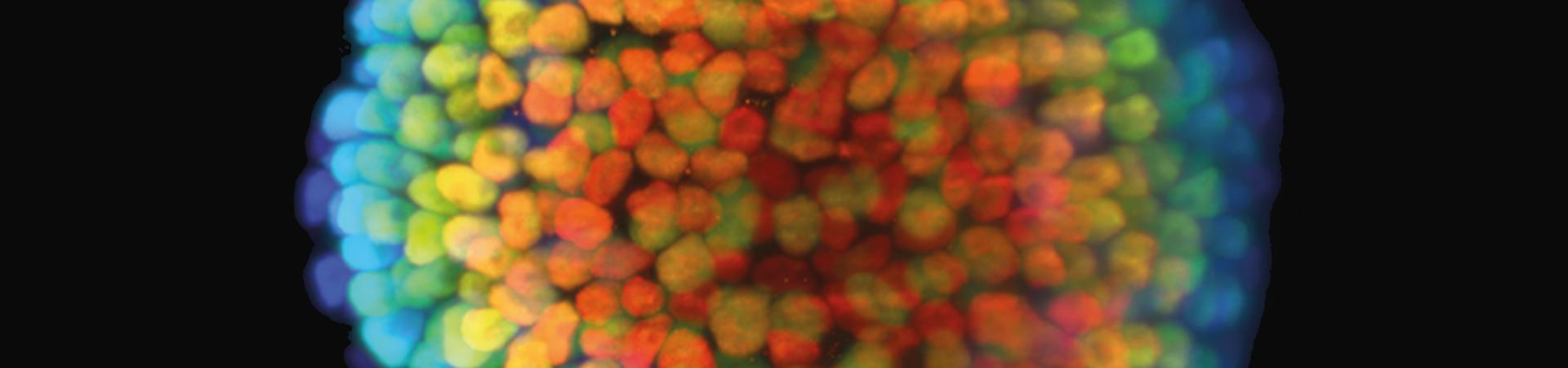
Fluorescence microscopy excites fluorophores with light and detects their emitted fluorescence. Oxxius lasers and wavelength combiners provide the stability, beam quality and flexibility required across modern modalities.
Fluorescence imaging principles
What makes a precise wavelength control critical in fluorescence microscopy?

A fluorophore (or dye) absorbs photons that are within its excitation range and re-emits some light at a longer wavelength. In most situations, however, the ranges (or spectra) of the excitation and the emission overlap significantly, making part of the excitation signal indistinguishable from the genuine fluorescence signal. That issue is solved by employing a dichroic filter that cuts off the excitation light, preventing it from reaching the collection beam path as a background noise.
As a consequence, the choice of the excitation wavelength is guided with these two constraints in mind:
- To exhibit a high absorption ratio that will reduce the amount of excitation power required, thus reducing the phototoxicity of the imaging process
- To remain at good distance from the cut-off wavelength of the dichroic mirror that separates the excitation and the collection beam path.
A precisely selected excitation wavelength should solve the tradeoff between those two constraints and thus yield to a vivid image contrast.
Laser requirements for fluorescence microscopy
Why are lasers crucial for fluorescence imaging?
Laser sources deliver the specific excitation wavelength that, applied to the appropriate dye, will maximize the signal-to-background ratio, with high irradiance, an excellent spatial mode, and a fast modulation. Key requirements also include:
- The wavelength compatibility with targeted fluorophores and filter sets
- High power stability to ensure quantitative, reproducible intensity measurements
- High beam quality (TEM₀₀) to create either a compact point spread function (in confocal imaging) or a uniform illumination (widefield, light sheet imaging)
- Low noise to reduce flicker
- Compact, easy-to-use hardware with minimal maintenance
- Fiber delivery options (SM, PM, MM) for an immediate interfacing with a microscope or a spinning disk
Multi-line excitation & modular combiners
Why choose Oxxius for fluorescence microscopy?
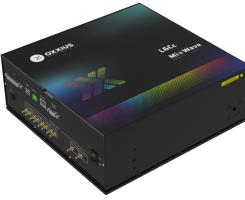
Most experiments need multiple excitation lines to address diverse labels. Oxxius MixxWave combiners integrate up to 6 lasers into one co-aligned output, simplifying the alignment while preserving the beam quality. The flexible architecture can scale from a few lines to large, multi-color sets, supporting advanced techniques from epifluorescence to TIRF, spinning disk, SMLM, light sheet imaging, etc.
Oxxius wavelength combiners for fluorescence
Oxxius develops modular, field-configurable combiners spanning UV to IR, enabling over a billion of line combinations across the Oxxius laser families. Options include dual independent channels, fast port switching, power balancing, and AOM-based modulation paths. Fiber outputs are available in SM / PM / MM for a simplified interfacing with your microscope or your optical setup.
Featured product for Fluoresence Microscopy
Oxxius MixxWave Combiner: up to 4 or up to 6 lasers
Wavelength capacity: up to 6 lines in a single, co-aligned beam
Spectral coverage: UV to IR (e.g., 375, 405, 445/448, 488, 515/520, 532/561, 594, 633, 638/640/642, 660, 730–785, 1064 nm)
Output power: high per-line power for demanding modalities
Modularity: independent channels, fast output switching, power balancing, AOM integration
Delivery over SM / PM / MM fiber outputs for coupling into microscopy systems. Our PM fiber injection system can transmit TEM₀₀ beams from 405 nm to 1064 nm
Oxxius’ wavelengths portfolio for fluorescence microscopy
Select lines to match common fluorochromes and filter sets: 375, 405, 445/448, 488, 515/520, 532/561, 594, 633/638/647, 660, 730–785, 1064 nm. Combine lines strategically to minimize crosstalk while maximizing brightness and penetration depth.

Representative Oxxius lasers for fluorescence
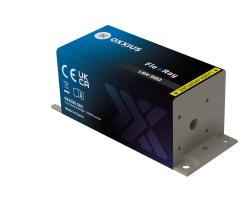
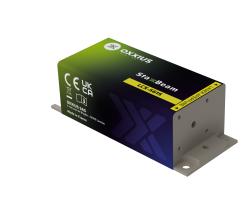
- LBX-405 / LBX-445(-450) / LBX-488 – Compact diode lasers for DAPI/Hoechst, CFP/AF448, GFP/AF488
- LCX-561S / LCX-532S – Excitation source at 561 nm with a long coherence length for structured illumination microscopy (SIM) and random illumination microscopy (RIM)
- LBX-638 / LBX-640 / LBX-660 – Red laser lines for Cy5/AF647 labels and
- LBX-785 – 785 nm excitation for deep-tissue imaging


All models emphasize power stability, spectral purity, beam quality, and longevity, with optional fiber coupling (SM/PM/MM) for rapid integration.
With Oxxius lasers and modular combiners, you get the wavelength coverage, stability and robustness that underpin quantitative, multicolor fluorescence microscopy, from routine epifluorescence to cutting-edge super-resolution.
Discover
Our product ranges