
Confocal microscopy
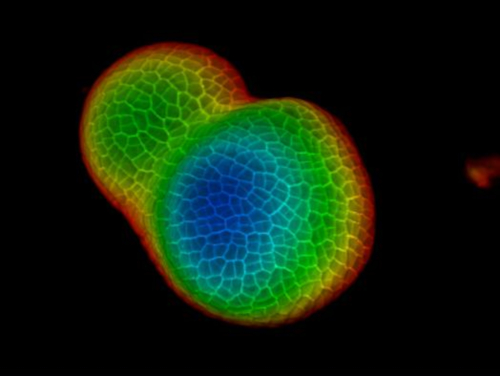
Confocal microscopy creates high-resolution, optically sectioned 3D images by rejecting out-of-focus light, Oxxius lasers and combiners deliver the precision, stability and flexibility these systems demand.
Principles of Confocal microscopy
Confocal imaging principles

A focused laser excites a single point within the sample; emitted or reflected light passes through a pinhole that blocks out-of-focus signal. Scanning point-by-point (and through z-stacks) reconstructs sharp, three-dimensional datasets. While the pinhole reduces raw signal, the gains in contrast and axial resolution are substantial.
Multiple scanning approaches exist (such as single-point laser scanning and spinning disk), each addressing different speed, sensitivity and field-of-view needs across life-science and materials applications.
Laser requirements & multi-laser configurations
Why are lasers crucial for confocal microscopy?
Performance hinges on delivering the right wavelength(s), sufficient and stable optical power, excellent beam quality, and fast, precise modulation. Using multiple laser lines is particularly advantageous for multicolor samples: each fluorophore has a distinct excitation peak, so combining several wavelengths enables simultaneous or sequential excitation with optimal contrast and depth. Different wavelengths also penetrate to different depths, helping reveal both superficial and deeper layers. In practice, you’ll select laser lines based on the fluorophores in use and the microscope’s detection sensitivity, balancing brightness, crosstalk and speed requirements.
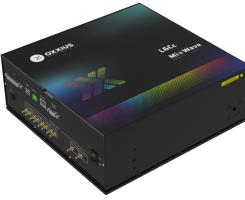
Oxxius MixxWave Laser Combiner
Why choose Oxxius for confocal microscopy?
Our MixxWave laser combiner provides a compact, flexible way to integrate multiple sources into a single, co-aligned output for confocal systems. It:
- Integrates up to six wavelengths into one beam for optimal fluorophore excitation.
- Covers a broad spectrum from 375 nm to 1064 nm, with up to 500 mW per line.
- Offers modular options: up to two independent channels, extension modules for fast output switching, power balancing or AOM integration for precise modulation.
- Supports single-mode, multimode, and polarization-maintaining fiber coupling, ensuring compatibility with diverse microscope platforms.
- The scalable design lets you add lines or features as needs evolve, future-proofing your imaging setup.
Featured product for confocal microscopy
Oxxius MixxWave up to 4 or up to 6 Laser Combiner
- Wavelength capacity: up to 6 lines into a single beam
- Spectral coverage: 375–1064 nm
- Output power: up to 500 mW per line
- Channels & options: up to 2 independent channels; fast port switching; power balancing; AOMs for high-speed blanking/modulation
- Fiber delivery: SM / MM / PM options
- Built to maximize multicolor performance and day-to-day reproducibility in point-scanning and spinning-disk systems.
Oxxius’ wavelengths portfolio for confocal microscopy:
Representative excitation lines for common fluorophores include 375, 405, 445, 488, 515, 532, 561, 594, 633/638, 660, 785 and 1064 nm, select the set that best matches your dyes and imaging strategy.

Related products
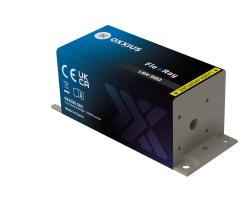
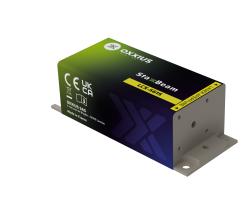
- LCX-561S – Narrow-linewidth 561 nm for green/yellow-excitable fluorophores in confocal imaging
- LBX-488 – 488 nm laser for widespread blue-excited labels
- LBX-405 – 405 nm line for nuclear dyes and photoactivation
- L4Cc – Compact multi-line combiner for space-constrained microscope integrations


With Oxxius lasers and wavelength combiners, you can rely on wavelength coverage, stability and robustness: the foundation of high-contrast, high-resolution confocal microscopy.
Discover